Design Against Collapse
How might we create living infrastructure that scaffolds your life when every other system has nothing left to give?
I have a career, a graduate degree, a house. I have a Roth IRA that I set up in a moment of momentum, but have ignored ever since. By many external measures, I am a functioning adult, but there are weeks where I cannot open an email. Weeks where I know exactly what to do, but I can't make myself do any of it. Weeks where I can't sleep, forget to eat, or can barely text back my best friends. Years that my ever growing to do list continues to roll over.
It's not for lack of trying or because I don't care. Instead something in my nervous system selectively declares a state of emergency and it's never provided me with a deescalation process.
I was diagnosed with ADHD as an adult. 15 years late, clinically speaking. Which means I spent most of my life developing extremely sophisticated workarounds for something I didn't even have a name for. While I was high performing on the outside, I was quietly detonating on the inside. It hit a head when I left home for college. The loss of structure, increased and different responsibilities, being in a new city with new people who have varying expectations and perceptions of me quickly overwhelmed me. I fell into a perpetual state of numb that didn't let up no matter what I changed.
It was as if I was lost and disconnected from any sense of self. Without solid structures or strategies to approach this new phase of life, I was intellectually and emotionally drained. I went from being numb to functionally frozen to burnt out to a long period of deep freeze. It wasn't depression, I wasn't sad. I was stuck. Things had piled up and I was in full blown analysis paralysis as I suffocated under the weight, fear, and shame at how many balls I could be dropping and people I could be letting down.
I had relied on those feelings for so long. The guilt and anxiety… they used to work. They made things uncomfortable enough for me to keep on keeping on. Yet, somewhere things broke down and they stopped working as blockers for my behavior and instead became constant, ambient, inescapable noise.
Until my body, well, no, until my nervous system couldn't take it. I was forced to claw myself out, slowly and painfully. Relying solely on adrenaline and sheer force of will. I was able to reset, and that was enough proof for me that I was okay.
I'd convinced myself that this was normal. This was just what life was like for everyone. You can't have summer without winter. You can't know happiness without experiencing sadness. I believed that losing the plot every few years was just another part of being human. It was expected, unavoidable, and maybe a little necessary. People hate their jobs. They drift away from their goals and ambitions. They fall apart and put themselves back together. That's just how it is, and I was going to learn to tolerate it and charge it to the cost of being ambitious, alive and trying.
Until it kept happening.
Different cities. Different jobs. Different relationships. Different versions of me drowning in the same fog wondering how I got here again? Every time the damage was worse. The debt was larger. The recovery took longer. And the shame was louder. I got better at navigating and surviving it, but I never understood how to stop it.
This has been the longest and hardest cycle to date, but I promised myself it would be the last. So instead of battling my way out, I decided to stop surviving it and start studying it.
My background is in CS and Sociology, which fits for a person who can't stop asking why. I've landed in innovation product management dreaming of the possible, within constraints. And that was the problem. There are too many constraints. Business constraints. Market constraints. User constraints. They pressure world class product teams to optimize for the middle. The average users, the median case, the people who the data already supports.
After years of hunting for the right device, system, app, or program, there's a trail of broken promises memorialized by every subscription I've canceled. None of them were built for me, because I'm not the middle.
It's time to stop waiting. No one was coming to save me.
Big tech is incentivized to capture my attention, not solve my particular problems. I've been building workarounds my entire life. This just happens to be my last one.
I've been journaling since 2013. Fourteen books filled with data. My problem was I couldn't read them. It was too close, too emotional, and there was too much of me in the way of my analysis.
So, I created a world for this project; a Substack framed as a lifestyle consultancy for one client: me. I gave myself distance by assigning myself a role. I wrote about Jada the way a product manager writes about a user in crisis. As an objective third party, with clinical separation, that's trying to understand why Jada, the system, kept breaking down in the exact same ways.
My initial objectives were simple: put my life back together and then stop the cycle. This can't happen again.
I wanted to understand my current state, how I got there, and what was blocking me from making a real change. Through my discovery, I unearthed patterns and spotted the same triggers across varied contexts. I could spot the déjà vu in the data as I dismissed the same entry points until it was too late.
My environment changed, but this loop never did. Neither did the tools I built or bought to manage it. And that was the problem.
Static scaffolding for a non-static life.
I validated this hypothesis through conversations with other high performers as well as those who experience high loads of persistent or repetitive stress due to their job as gig workers or their role as a new parent or caretaker. The details were different, but their core problems and frustrations were identical. Also, many didn't realize it, but we were all stuck in the same burnout loop.
This signaled to me two things. One, I wasn't an outlier. I was unaccounted for. Two, if I could build something that worked for me at my worst, it would probably work for a lot of others whose needs have never been designed.
I wasn't an edge case. I was the blueprint.
I went into my discovery conversations seeking some confirmation that I wasn't broken. Instead, I kept hearing the same frustrations over and over.
First principles are the truths you can't ignore and things you can't undiscover. "How might we…?" is a design thinking framework that turns insight into inquiry by reframing hypotheses, problems, opportunities, and opinions into questions worth answering. The following HMWs are not experiments; they are positions. Each one takes a bet on where the market has failed and where users were abandoned.
Most productivity systems are built for those who already know what they need. It's assumed that the user can identify their problem, select the right tool, and initiate the right behavior.
Charting my own patterns revealed something these systems rarely account for: user capacity isn't constant. It fluctuates. The moments that demand the most are precisely when systems are able to provide the least.
Designing support that only works when you're already functioning isn't design oversight. It's design malpractice. For many, the pattern isn't simply a bad day. It's their primary operating logic. The same pressures. The same progressions. The same exit ramps, missed.
It's not for lack of trying. The available support was designed for someone who actually slept last night. I'm convinced that people fail to maintain change partly because systems have been built to assume a level of executive function that isn't available in the moments when help is needed most.
That's the gap I need to tackle — and it forces the question: how might we create living infrastructure that scaffolds your life when every other system has nothing left to give?
By charting my operating logic and failure patterns with enough depth, what emerged was a system of recognizable states, consistent transitions and triggers, and return paths that loop you back to where you started.
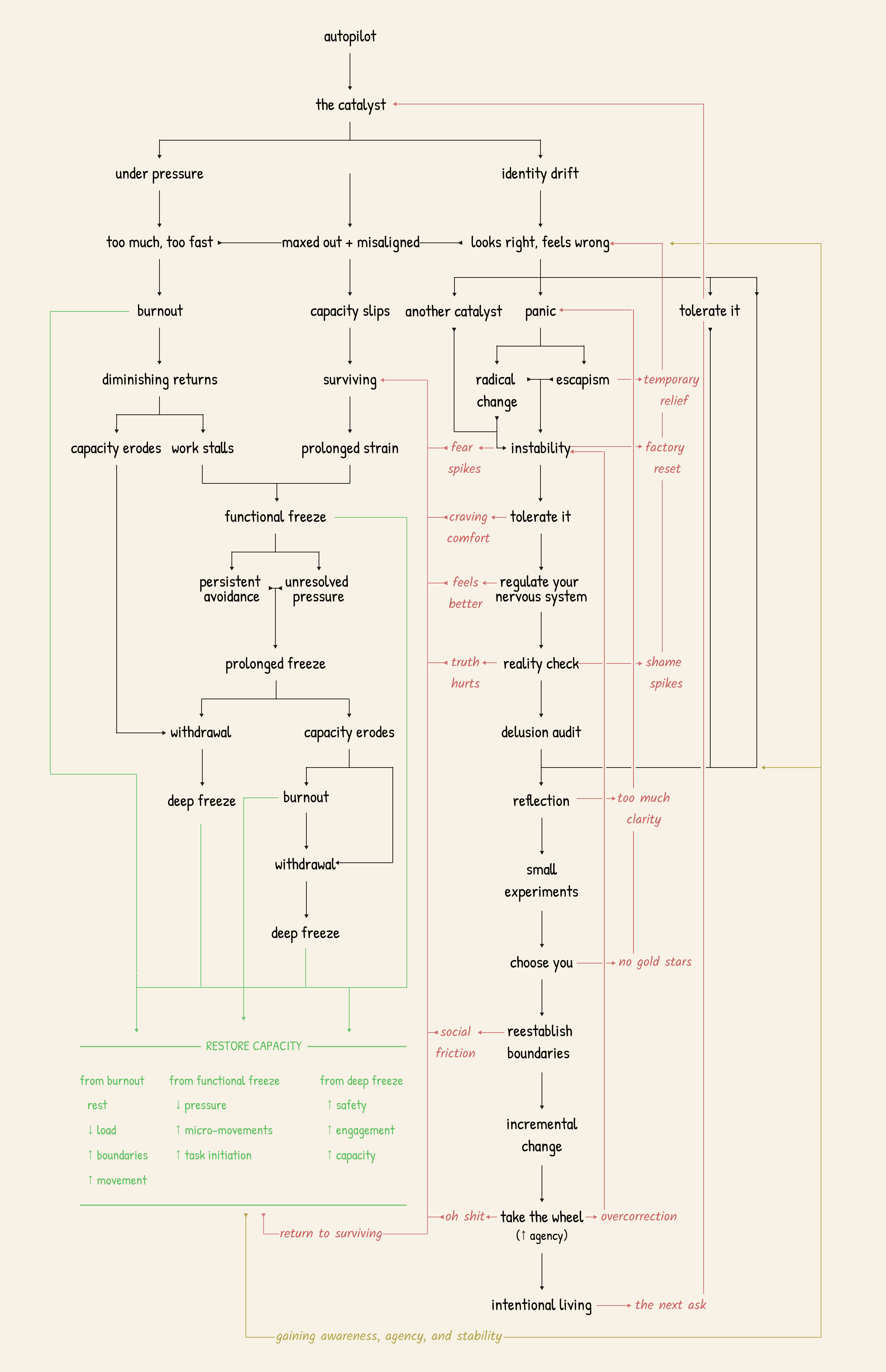
The following states the conditions under which this product makes sense. Everything that follows will be evaluated and built against these premises.
| Mandate | We are a design house dedicated to humane design for living well in the post-digital era. Our practice sits at the intersection of product design, technical architecture, cognitive science, and life design. We study people at the point of collapse, because failure is where design tells the truth. Our clients' experiences magnify universal problems. We build where the need is unambiguous and the standard answer has already failed. |
| Problem | Existing life management and productivity tools were built for users who can initiate on their own. They assume their users have enough executive function to open the app, read the list, decide where to start, and then execute the task. That assumption fails at the exact moment when it's needed most. |
| Client | Our client is high-performing, and is exceptional until they are not. The distance between those two states isn't a slope, it's a ledge. But it's not random. The entries and exits rhyme. The loop is plottable. |
| Remit | Along the Autopilot to Intentional Living Circuit, the system needs to support clients at five points. These become the workflows we are designing to solve.
|
I've spent my semester focused on the backend frameworks for this application in an attempt to achieve the aforementioned Remit, but along the way it became clear that I was struggling to communicate what I am building. Thus below is the first concept, which is being used to highlight how I'd like to capture and visualize data to inform and protect our users as well as calm their nervous systems via data design.
As a high-performing ADHDer resurfacing after functional freeze or burnout, I have not properly checked my inbox or calendar since early 2023. I'm struggling with most of the dimensions of my life: emotionally, mentally, physically, socially, financially, and romantically. I'm ready to check back in, but I have no clue where to start. Every potential re-entry point carries enough weight to prevent me from starting at all.
My inbox has 2% space left. The thought of sorting through it is paralyzing. There are friends I haven't replied to in months, if not years. I need to reach back out, but the accumulated silence makes replying feel like a confrontation. I also know that the second a new text comes through, I'll avoid it like the plague. My to-do list gets heavier as I lose clarity and control over the situation.
I miss meetings. I never know where I'm supposed to be. Time is my unreliable enemy. I leave without my coat and return to grab my umbrella.
I don't need another app. What I actually need is a mom, a wife, a chief of staff, a therapist, and a coach, in that order. Not the kind that catalogues everything that went wrong, but the kind that already knows, and keeps asking where you want to go next.
I've stopped looking for tools to optimize my workflow. Instead, I'm on the hunt for something that will hold the weight of my world while I find my footing. Something that will quell the surface-level chaos so I can begin to function again. Something that will not ask me to make a single decision I don't have the capacity for. And I need it on Day Zero.
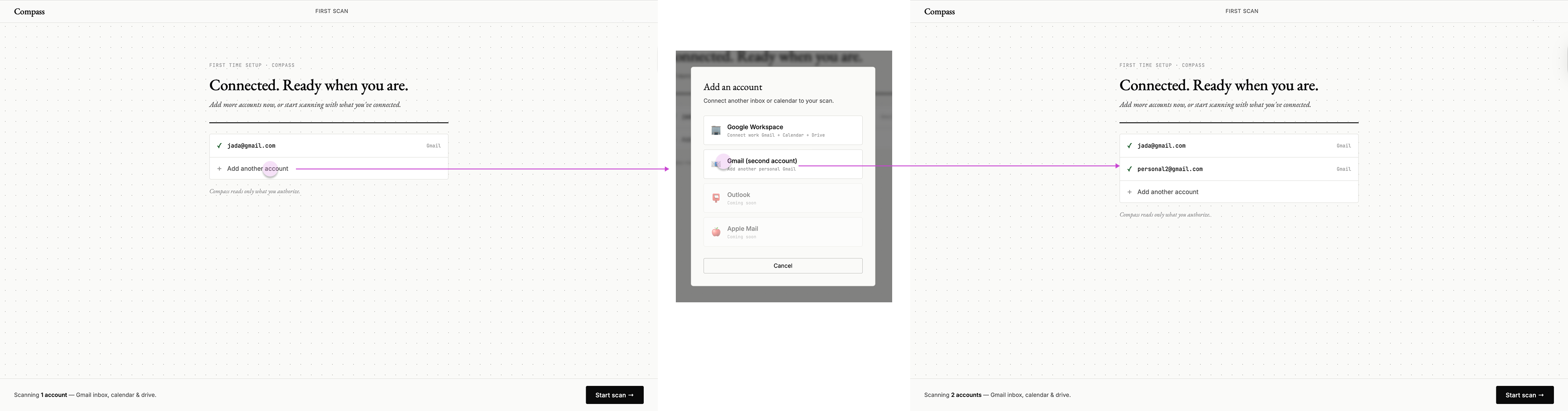
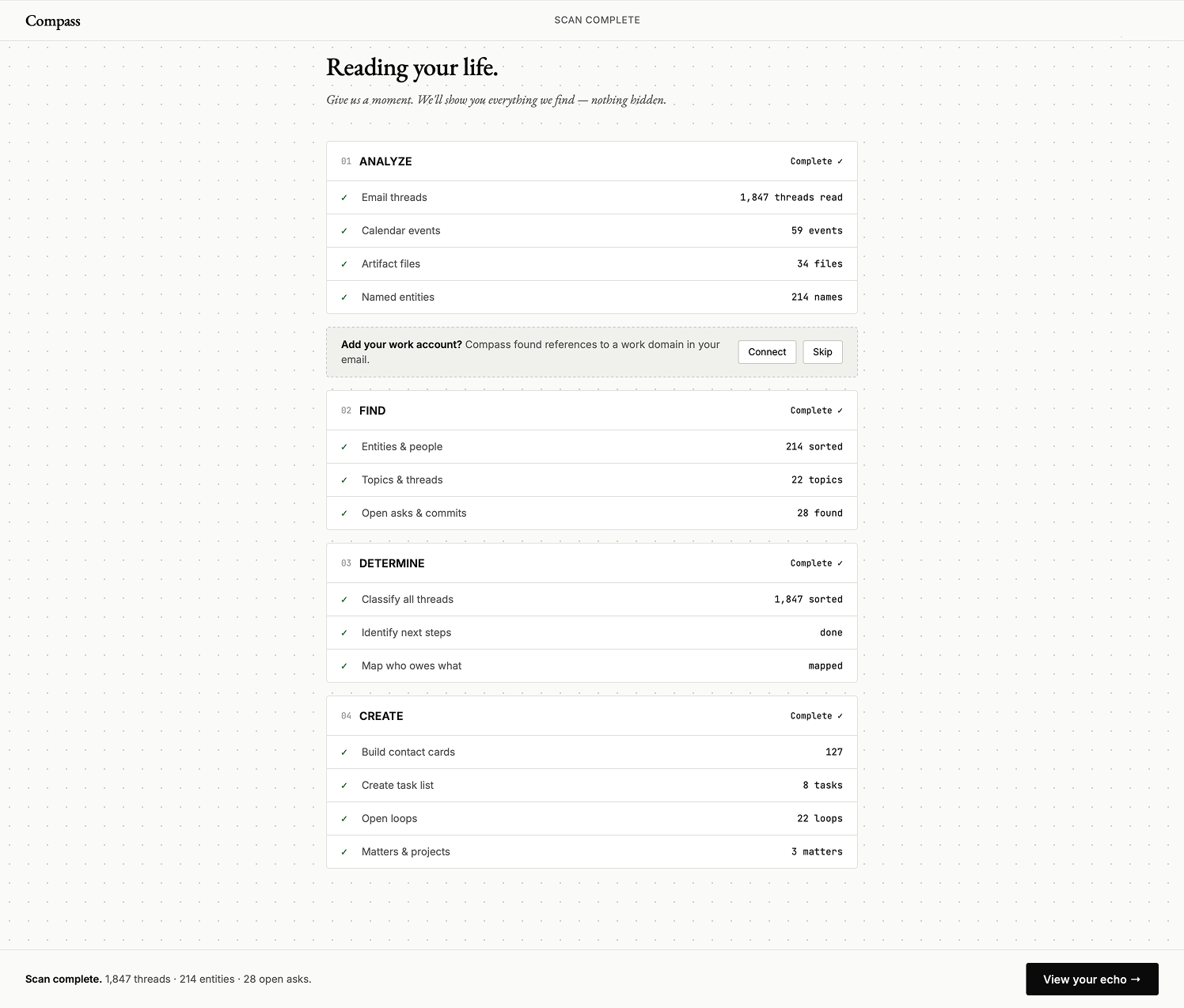
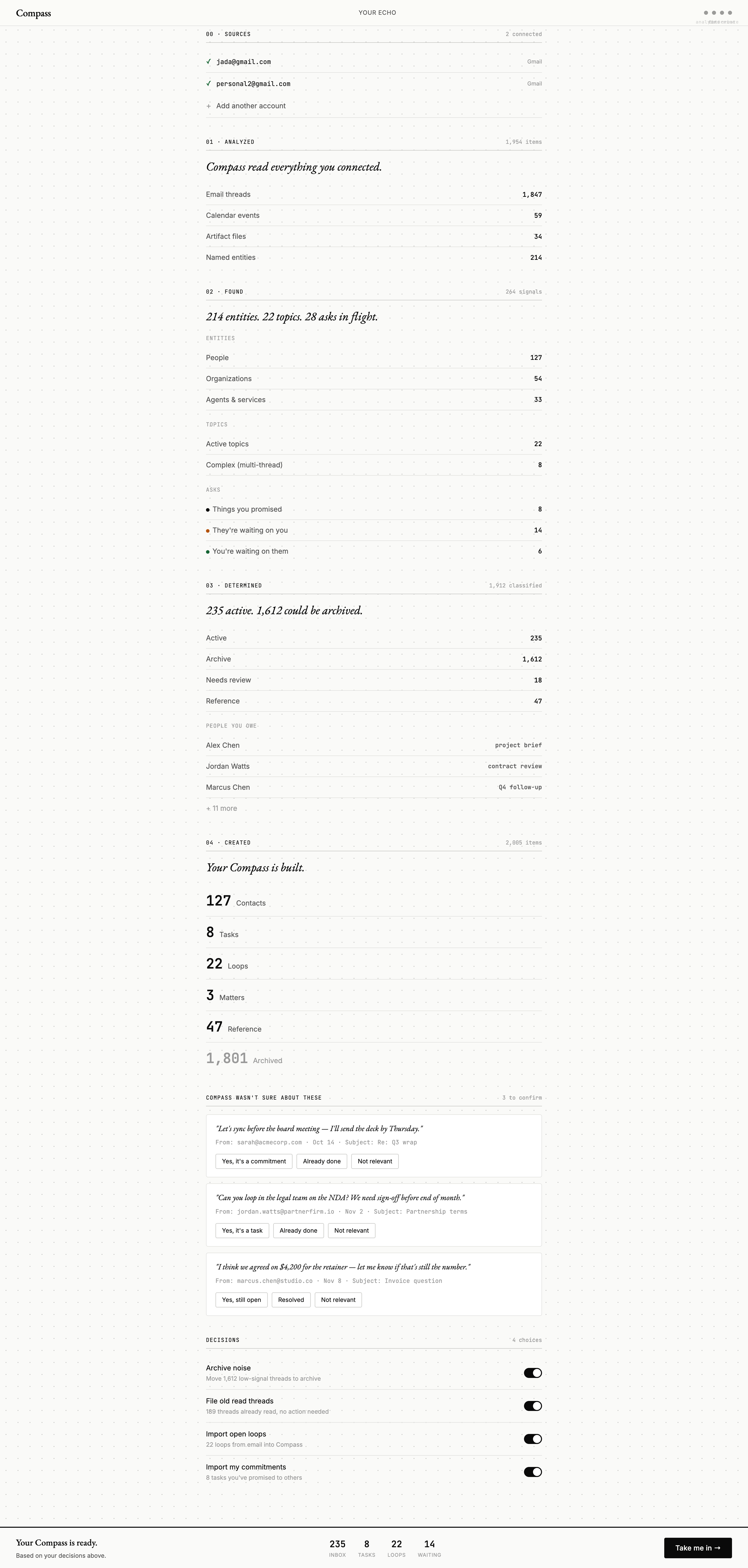
I have yet to implement a frontend for the remainder of the application, but my backend logic model, AU, has been designed to do just that.
Most systems build your profile and then spend the rest of their lives being wrong about you. This isn't that. AU is a live reading. Three layers, three speeds, one picture of who you are and what you can actually handle right now.
Permanent. Accumulated. Not up for debate.
Factory settings are the durable facts about a user. Their cognitive profile, their known collapse triggers, their relationship to avoidance, and the specific entry points that precede a freeze. These are not preferences or moods. They are operating constraints that do not reset between sessions, but update when there's solid evidence.
Dynamic. Detected. Never reported.
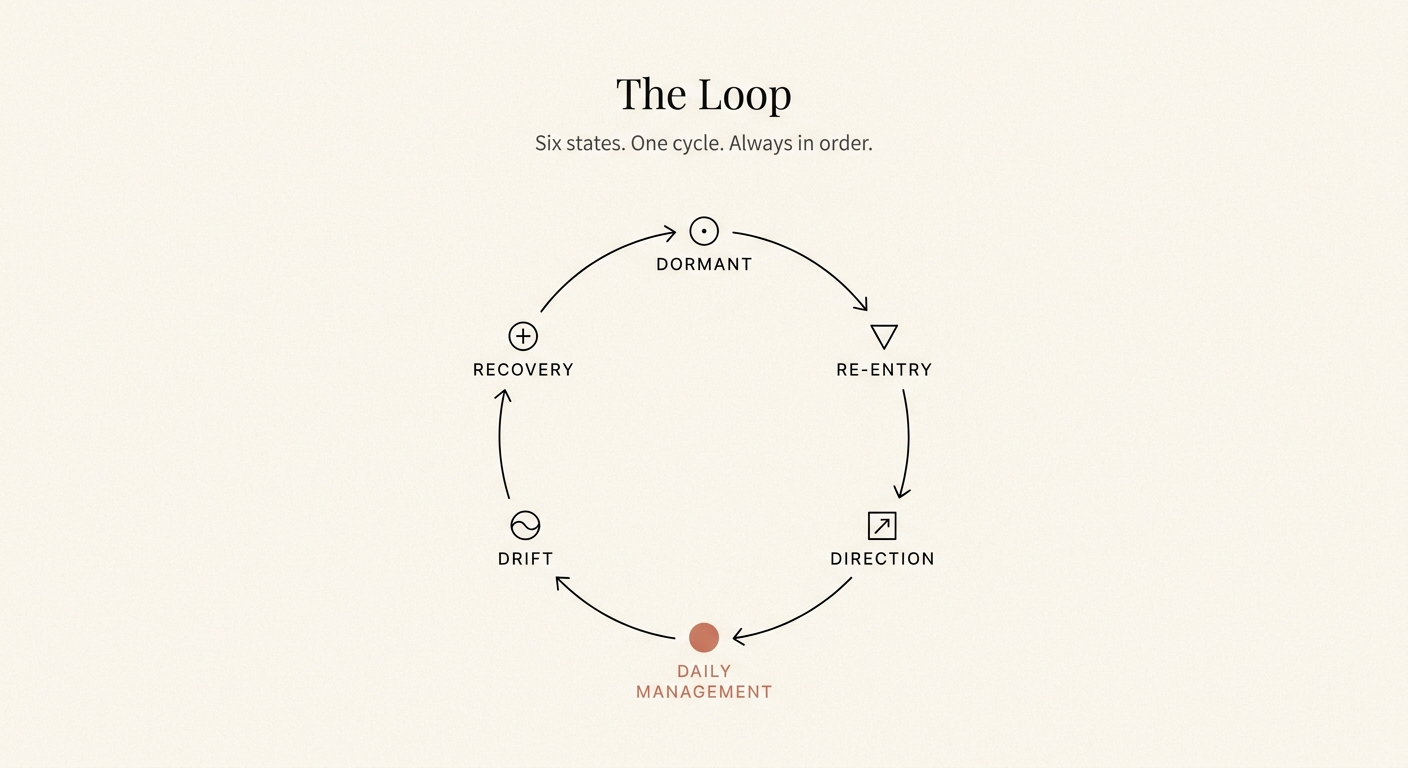
Active Loop determines where a user currently sits in the cycle from autopilot to intentionally living. The system infers user state from signals like inbox saturation, calendar shape, response latency, and their particular texture of absence.
Users might not know where they are, but the layer always will. I simplified my burnout loop into six states, with client intake always beginning in the dormant phase.
Vitals provide a real-time read across the dimensions that actually determine what a person is capable of: cognitive load, emotional charge, somatic state, and attention window. We are not prioritizing productivity or motivation, but the underlying conditions that make those things possible or impossible.
Vitals surface every user's threshold. It's not a question of if the intervention is good. It's whether this person, right now, can receive and act upon it.
AU is not a single layer. Its value comes from the convergence of all three.
Factory Settings clarify how a user collapses. Active Loop indicates where they are right now on the path to intentional living. Vitals highlight what they are capable of right now.
Most systems select one lens to optimize for. AU simultaneously processes the three layers and then decides your next best step and experience. Meaning the same user in the same state with different vitals will generate a different response.
This is what separates AU from a rules engine, that applies the same logic regardless of who’s receiving it. AU applies the same logic to different readings. What the system does with that reading, what it surfaces, what it holds, and what it skips entirely is determined by the State-Aware Operating Model. It defines the application protocols based on what’s inferred from AU. That architecture is being defined in my Digital Operations final project